It was a crazy busy summer at the Nelson County Community Development Foundation and things are not slowing down! We finally finished the Roseland (St. James Place) Apartments in May and are working feverishly on a new house for sale in Arrington - more details on that later! If you are interested in buying a house in Nelson County, pay attention to our blogs and social media posts.
We have been focusing these Homebuyer Blog posts on affordability, of course, and this one is no different. One of the most affordable homes you can buy is a Community Land Trust Home. What is a Community Land Trust Home, you ask? Good Question! We’ve got the Executive Director of the Piedmont Community Land Trust, Luis Oyola on hand to answer that question and more!
Q: Hi Luis! Thanks for answering our questions on Community Land Trust Homes! Can you tell us what a Community Land Trust Home is?
A: The easiest way to explain a community land trust (CLT) is by defining each word in the name: “Community” refers to the community-led vision of each CLT and the fact that all CLT properties are to serve a specific community need, typically a need that’s hard to meet in the current economy (ex. housing). “Land” refers to the ownership model, where every CLT owns the land for each of its properties, but does not have ownership for the home or buildings on the land. “Trust” refers to the long-term outlook of the CLT’s mission, where the ownership model permanently remains in place, ensuring its properties can serve their specific community needs for generations to come. Sometimes CLTs get mixed up with conservation trusts or heir trusts – the “trust” concept is the same in that a specific use or purpose for a property is legally protected, but the big difference is in the community-serving aspect and the fact that ownership of the home is separated.
The Piedmont Community Land Trust (PCLT) is a regional CLT that provides and preserves permanently affordable homeownership opportunities for Charlottesville, Albemarle, Nelson, Fluvanna, Louisa, and Greene. We employ the CLT ownership model in order to guarantee a number of homes for sale at prices that are actually affordable to people, even when market-rate prices are inflated. As of 2026, we have 55 permanently affordable homes, with many more to come in the next 4-5 years, including in Nelson County. To learn more, visit https://piedmontclt.org/
Q: How can I buy a house without the land?
A: The purchase process for PCLT homes is very similar to any other home – our buyers have to qualify for a mortgage, they gain title to their homes, pay taxes, add improvements, pass them to heirs, etc. Property records already make clear legal distinctions between “land” and “improvements” (aka. The home). For the land, buyers enter a 90-year renewable ground lease with a monthly fee ($25/month) that sets certain terms to ensure the home remains affordable and in good condition in the future. The two most important terms for people who are curious are: 1) when the home resells, the ground lease will set a maximum sales price using a resale formula and, 2) the home must be the owner’s primary residence (no short-term rentals or investment properties allowed).
We get a lot of questions about whether or not we “control” what people do on the land (ex. garden, run a business, etc.), and we simply don’t - the ground lease protects the homeowner from “encumbrance” by the PCLT as long as it remains in effect. The reason we do this form of shared ownership is that a ground lease is a very strong legal mechanism for shielding PCLT properties from the effects of inflation in the broader real estate market. The oldest CLT in the country, New Communities, Inc., was founded in 1969 in rural Georgia. That is 50+ years of history where the model has proven itself as a successful tool for community and affordability preservation.
Q: Is there a huge price difference between a Land Trust home and a “regular” home?
A: For homes that the PCLT sells for the first time, the sales price difference has ranged between $20,000 to $160,000 lower than the appraised market value. For example, in 2025 we sold 8 new townhomes in Albemarle County that were valued at $400,000 but sold at $275,000. That means huge savings for the buyer, because it’s the PCLT who is investing and locking in that difference in value to make the home actually affordable. Even $20,000 can mean the difference between someone qualifying for a mortgage or having to continue renting.
Over time as the homes resell, though, the difference between the resale price and market value grows. To put numbers to it, the PCLT sold a new 3-bedroom home in Charlottesville in 2019 for $215,000, and it had a market value of $300,000 at that time – $85,000 in savings for the buyer. When they resold the home in 2022, the market value increased to $400,000. However, the way we calculate resale prices for our homes is that we take 25% of the market appreciation ($25,000 in this case) and add it to the original sales price to establish a maximum sales price. That means their home resold for $240,000 – a $25,000 wealth gain for the seller, but a whopping $160,000 in savings for the next buyer.
Q: What are the pros and cons of buying a Community Land Trust home?
A: As the math above suggests, the most obvious drawback of the CLT model is that our homeowners do not earn the full market value of their home when they resell it in the future. This is the core tradeoff of the PCLT, as we know that if we cap the resale value of the homes, that means future buyers can afford to buy our homes, whether that’s 10, 30, or 50 years from now. Past PCLT buyers have described this model as the “pay-it-forward" approach to homeownership, and they are proud to be part of it.
Once people understand the model, they can see the real benefits of the CLT:
Real chance to become a homeowner when housing costs elsewhere are too high
First step at building equity and wealth for future generations
The PCLT as an organization is permanently by the side of each homeowner to help navigate mortgages, taxes, HOAs, and more
Virginia law requires lower real estate taxes for CLT homes (§ 58.1-3295.2. Assessment or exemption of certain real property conveyed or owned by a community land trust)
Q: What happens if I want to sell my home?
A: The basic steps for resale of a PCLT home are:
The owner notifies the PCLT of their intent to sell.
The PCLT has the right to be the first buyer of the home (aka. “right of first refusal”). If not, the PCLT assists the seller in finding a qualified buyer.
The PCLT sets a maximum resale price using the following formula: Original Sales Price + 25% of Market Appreciation = Maximum Resale Price.
The home is sold to a new qualified buyer who enters a new ground lease.
Q: How does a CLT affect the equity that I will earn in my home?
A: The equity a PCLT homeowner earns from paying off their mortgage is no different than conventional homeownership. That is, if a homeowner has paid down 50% of their mortgage when they decide to resell, they can earn that 50% equity back at closing. The PCLT does not touch that. In addition, the 25% of appreciation that is added to the original sales price is cash for the homeowner as well. The PCLT does not make money from resales done by PCLT homeowners.
The main effect of the CLT model on earnings on a home is that the appreciation is capped at 25%. So, for example, if a home value has increased by $100,000 over a 10-year period, the seller can add up to $25,000 to their sales price. But the CLT model does not affect the owner’s equity gained from paying off a mortgage or from having a clean title to the home.
Q: Who makes the rules surrounding the CLT homes? Will I be involved in the process?
A: The rules of the PCLT are in each homeowner’s ground lease. The terms of the ground lease are reviewed and approved by the PCLT’s Board of Directors, which includes representation from PCLT homeowners and community beneficiaries (we currently have an open seat for a PCLT homeowner!). The PCLT lists the ground lease terms publicly on our website: https://piedmontclt.org/steps-to-homeownership/ (see PDF links available under “Resources”).
To be clear, our ground lease terms focus on ensuring each PCLT home will remain a good quality, affordable home for future generations. Up until the point of resale, the rules that PCLT homeowners tend to encounter much more frequently come from HOA’s, local ordinances, taxes, and other aspects of homeownership, with or without CLT’s.
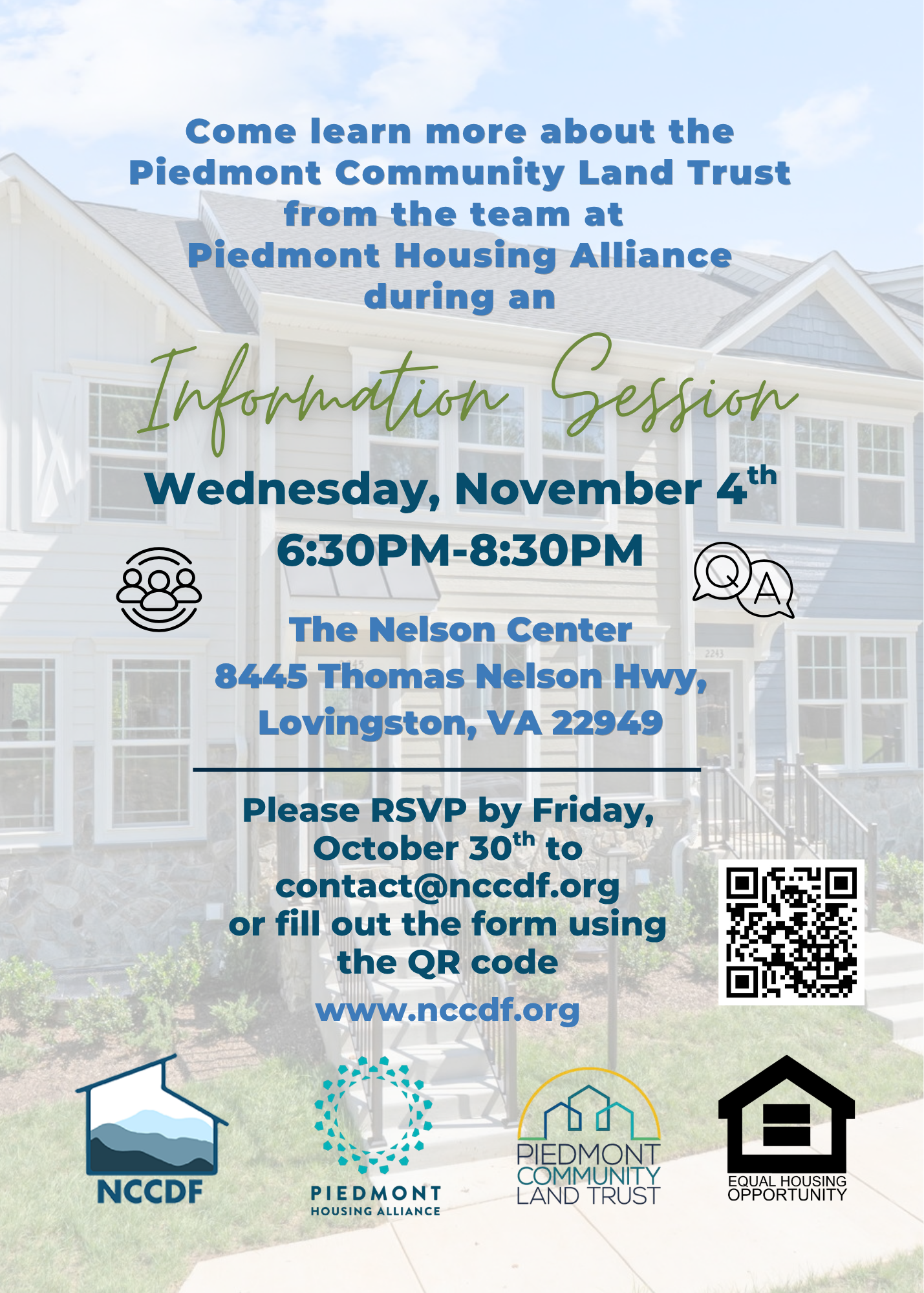
If you’d like to learn more about PCLTs, there will be an information session held on Wednesday, November 4th from 6:30-8:30PM at The Nelson Center. Anyone is welcome to attend, but please fill out our form here so we know how many to anticipate.